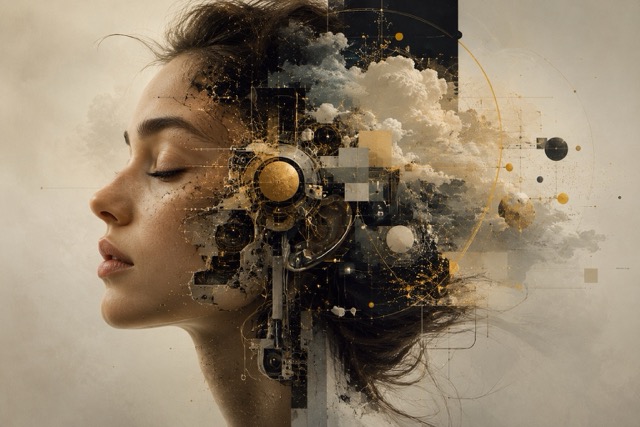
There’s a quiet question that keeps appearing as Artificial Intelligence becomes part of our creative process.
If AI helped me write, think, structure or visualize this… is it still mine?
It’s a fair question. Most people aren’t afraid of AI itself. They’re afraid of becoming more productive while feeling less present in their own work. They’re afraid of gaining speed while losing their voice. They’re afraid of looking at an article, a presentation or an image and realizing that, although the result is polished and technically impressive, it no longer feels like something they created.
The real risk isn’t AI
The conversation often focuses on whether AI will replace creativity. I think that’s the wrong question.
The real risk isn’t using AI. The real risk is allowing AI to replace the space where thinking should happen.
Generative AI can transform an idea into text, images, code or entire narratives. It can reorganise information, generate alternatives, identify patterns and dramatically accelerate execution. What it cannot do is have intention. It has no lived experience, no personal perspective and no understanding of why one idea matters more than another.
AI generates possibilities.
Humans provide direction.
That distinction changes everything.
Authorship is about decisions
When someone asks AI to write an article and publishes the first response almost unchanged, something subtle happens. The content may be accurate, well-written, and visually appealing, but it begins to lose its identity. Not because AI created it, but because the human stopped making meaningful creative decisions.
On the other hand, when someone starts with an original idea, provides context, challenges the output, removes weak arguments, adds experience and shapes the final message, AI becomes exactly what it should be: part of the creative process rather than the creator itself.
Authorship has never been about typing every word manually.
It’s about making the creative decisions that shape the final work.
Who defined the point of view?
Who decided what stayed and what disappeared?
Who recognised that a paragraph sounded convincing but wasn’t actually correct?
Who rewrote the ending because it didn’t reflect the intended message?
Those decisions belong to a person, not to a model.
What does European law say?
This distinction also matters from a legal perspective.
Using AI does not automatically mean you lose ownership of your work. European copyright law continues to place human creativity at its centre. What matters is whether there has been a sufficiently creative human contribution to the final work.
The AI Act doesn’t change this principle. Its purpose is to encourage responsible AI adoption by introducing transparency obligations in specific situations, particularly for certain AI-generated or manipulated content that could mislead people.
In other words, transparency isn’t the same as losing authorship.
Using AI responsibly doesn’t make your ideas any less yours.
The future belongs to people who can think
As AI becomes available to everyone, access to technology will stop being a competitive advantage.
Execution is becoming a commodity.
Thinking is not.
The people who stand out won’t necessarily be those who use AI the most. They’ll be the ones who know what to ask, what to ignore, what to challenge and what should never be delegated.
Taste.
Judgement.
Experience.
Vision.
These remain deeply human.
Perhaps the defining question of the future won’t be:
“Was this created with AI?”
Perhaps it will be:
“Can I still recognise the person behind it?”
If the answer is yes, then AI hasn’t replaced creativity.
It has amplified it.
If you can recognise my thinking, then AI did its job.
— Tânia Costa
No responses yet