Understanding the Difference and How One Evolves into the Other
Artificial Intelligence is evolving quickly, and one concept that keeps appearing everywhere is the AI agent.
But something interesting happens in many conversations about AI: people often use AI agents and AI systems as if they were the same thing.
They are not.
In fact, they represent very different levels of architectural maturity.
Understanding this difference is important if we want to move from small AI experiments toward intelligent systems that actually scale inside organisations.
A simple way to think about it is:
Agents perform tasks.
AI systems enable intelligence across an organisation.
What is an AI Agent?
An AI agent is essentially a piece of software that can perceive information, reason about it, and take an action to achieve a goal.
This idea is not new. It comes from classical AI research on intelligent systems (Russell & Norvig).
At a conceptual level, most agents follow a simple loop:
Perception → Reasoning → Action → Feedback
First the agent receives information, a prompt, some data, or signals from its environment.
Then it reasons about that information and decides what to do.
Next it performs an action: generating an answer, querying a database, calling a tool.
Finally, it evaluates the result and continues the cycle.
Many modern agents are powered by Large Language Models (LLMs) and connected to tools such as APIs, databases, or automation systems.
Some familiar examples include:
- a chatbot answering customer questions
- a coding assistant generating scripts
- a data agent querying a database and returning insights
These systems can be surprisingly capable, but they usually remain focused on a specific task.
That focus is what distinguishes them from something larger.
What is an AI System?
An AI system is something much broader.
Instead of being a single agent, it is a technological ecosystem designed to deliver intelligent capabilities across a product, a platform, or an entire organisation.
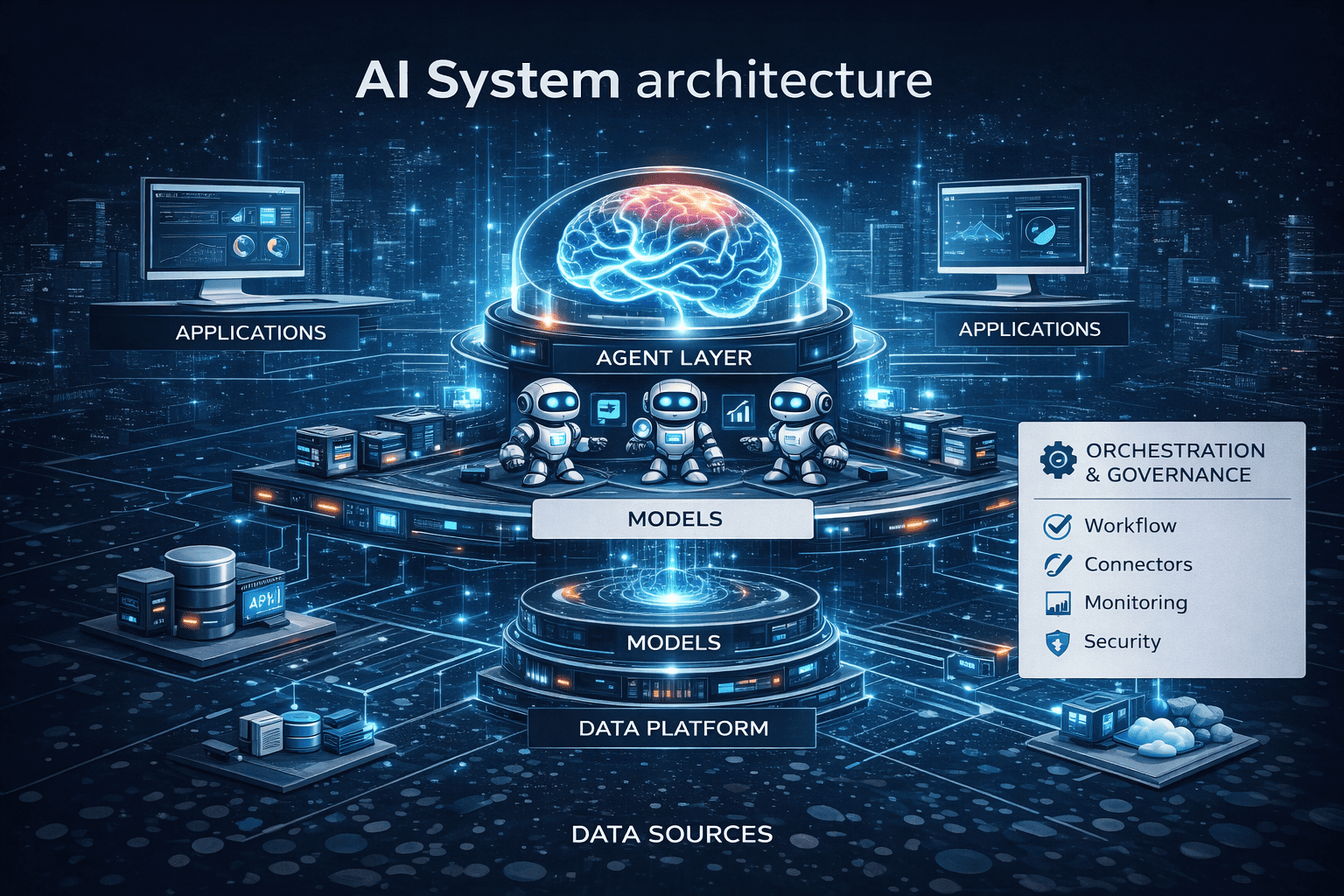
Behind the scenes, an AI system usually combines multiple layers of technology:
data pipelines, machine learning models, AI agents, orchestration layers, APIs, monitoring tools, and governance mechanisms.
Because of this, an AI system must handle challenges that go far beyond a single agent:
- ingesting and processing data
- training and deploying models
- coordinating tools and services
- scaling reliably
- ensuring security and governance
In other words:
An agent performs a task.
An AI system delivers intelligence at scale.
Agents often become building blocks inside AI systems, much like microservices inside modern software architectures.
How Agents Evolve into AI Systems
Most AI initiatives do not start with full systems.
They start with small agents solving narrow problems.
Over time, as organisations experiment and expand their use of AI, those agents begin to evolve into something more complex.
This evolution usually happens in stages.
The first stage is the single-task agent.
This is the simplest form an assistant that performs a specific function, such as summarising a document or answering a question.
The architecture is extremely simple:
User → Agent → Output
At this stage, the agent mostly reacts to prompts.
The next step happens when the agent gains access to external tools.
Instead of only generating text, it can query databases, call APIs, or trigger workflows.
Now the architecture looks more like:
User → Agent → Tools
The agent is still focused on one capability, but it can now interact with real systems.
As complexity increases, organisations often introduce multiple agents working together.
Each agent specialises in a different task one may retrieve information, another may plan actions, and another may execute them.
An orchestration layer coordinates the process.
This stage is often called agentic architecture.
Eventually, AI stops being a feature and becomes part of the core platform.
At this point the organisation has a full AI system.
This includes data infrastructure, model layers, agent layers, orchestration mechanisms, monitoring, and governance.
AI is no longer something experimental it becomes a capability embedded into the architecture of the organisation itself.
Why This Distinction Matters
One of the most common misunderstandings in AI today is that organisations believe they are building AI systems, when in reality they are deploying isolated agents.
That is not necessarily a problem.
It is simply the natural evolution of AI adoption.
But the difference matters because the impact is very different.
Agents automate tasks.
AI systems transform organisations.
Moving from one to the other requires much more than better prompts or bigger models.
It requires strong data architecture, scalable orchestration, governance mechanisms, and deep integration with business processes.
This is why roles such as AI Architects and AI Solution Designers increasingly focus on the entire intelligent architecture, not just individual models.
The Future: Agentic AI Systems
Looking ahead, many researchers believe the next generation of AI will consist of agentic systems.
These systems will combine autonomous agents, reasoning models, long-term memory, and workflow orchestration.
Instead of executing isolated tasks, they will coordinate complex decision-making processes across organisations.
In that future, the real challenge will probably not be building better models.
It will be designing better AI systems.
No responses yet